What interpretation hardware really costs (and why you probably don’t need it)
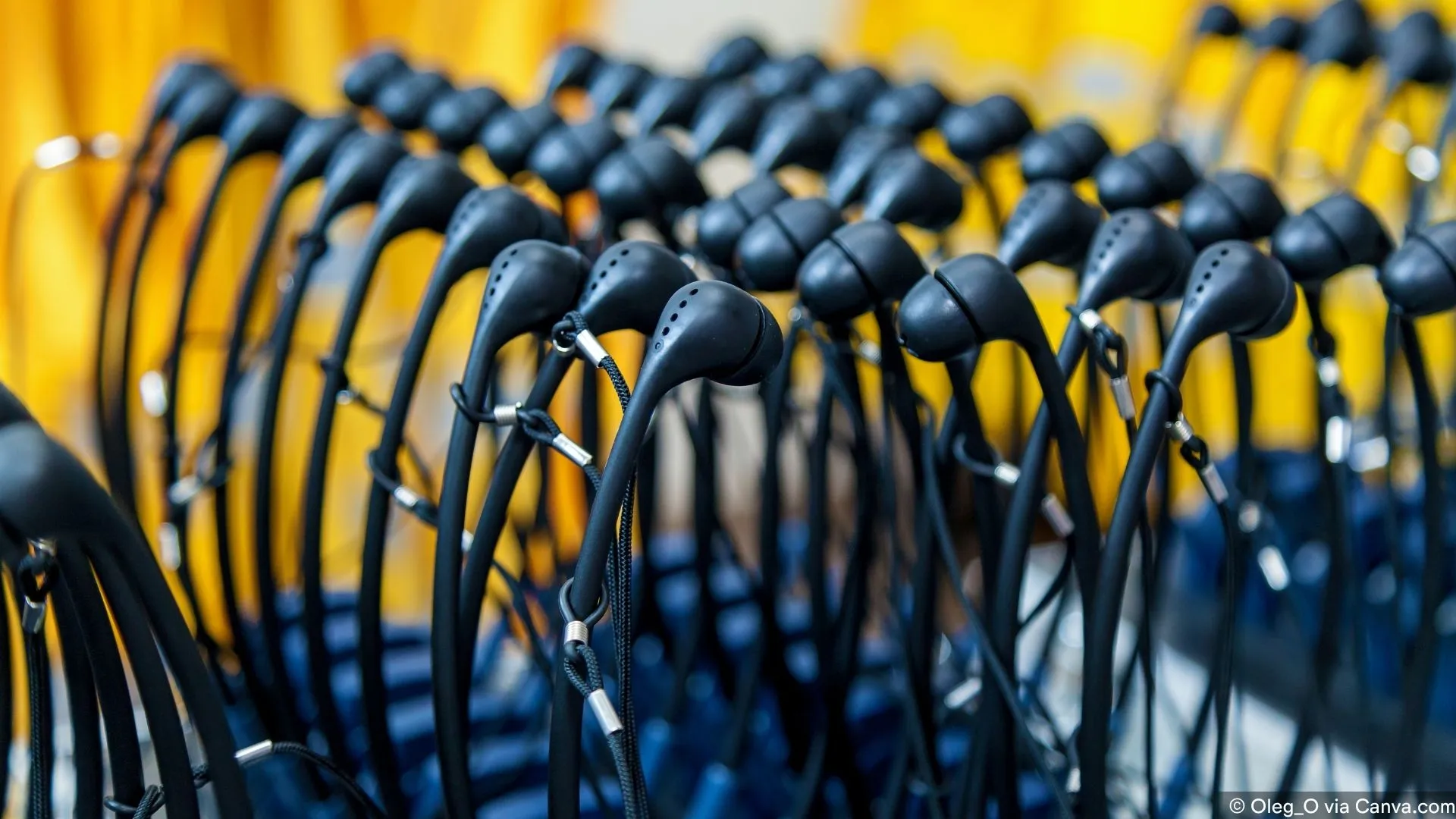
For a long time, the setup was simple. If your event needs interpretation, you rent the hardware. A booth, a transmitter, a hundred receivers, a technician, a van.
Nobody invented this to be difficult. It was the only way to get translated audio to a room full of people. So it became the default — and like most defaults, it stopped being questioned.
It's worth questioning now.
The setup everyone inherited
Think about what an interpretation setup actually is. A transmitter in one room. A booth with two interpreters. A hundred or so bodypack receivers. Headsets for each receiver. A technician to run it. Cases to ship it in. A registration desk to hand it out. A second desk to collect it.
None of this exists because someone sat down and designed the cleanest way to deliver translated audio to an audience. It exists because in 1995, if you wanted a room of 300 people to hear a speaker in their own language, this was the only thing that worked.
The logic held for a long time. Venues were built around it. AV companies priced around it. Organizers budgeted around it. A generation of event teams learned interpretation by learning headsets.
Then quietly, without anyone announcing it, the conditions underneath the whole setup changed.
What interpretation hardware actually costs
Rental is where most organizers look first. A hundred receivers for a one-day conference, a couple of headsets for the booth, a technician's day rate. It feels manageable on the first quote.
The real invoice builds from there:
- Per-event rental or purchase, scaling linearly with audience size
- Setup and teardown time, usually half a day to a full day of technician hours
- Shipping and transport, especially if your venue isn't in a major city
- Insurance, damage waivers, and replacement fees for lost or broken units
- Storage if you own the hardware instead of renting
- Charging and testing before every single event
None of this is optional. A missing receiver gets billed. A unit that didn't charge overnight is a missing receiver at 9:00 the next morning.
The purchase or rental price of a single unit tells you what one device costs. It tells you almost nothing about what interpretation will cost you across a year of events.
The moment expensive hardware stopped making sense
Here's the part of the story that usually gets skipped.
The reason interpretation equipment existed — and stayed around for three decades — was that the audience didn't have the hardware to receive audio themselves. So you had to bring it to them. A receiver per person. A headset per receiver. A technician to run it.
That assumption has changed.
The smartphone in your audience's pocket has better audio hardware than most rental receivers. It has a rechargeable battery the listener maintains themselves. It connects over Wi-Fi or mobile data. It runs an app in the background. It's already in the room, already paid for, already charged.
Your audience brought professional-grade audio receivers to the venue. They're just not the ones you rented.
This is the line worth sitting with: the hardware was solving a problem the audience has since solved for themselves.
So forget about expensive hardware. The equipment you've been renting every year isn't a requirement anymore. It's a legacy.
When you should still use the hardware
We'd rather be straight with you than oversell the alternative. There are cases where traditional interpretation equipment is still the right call:
- Venues with no reliable mobile signal and no permitted Wi-Fi
- Government or institutional events with strict no-personal-device rules
If that's your event, rent the receivers. The math works.
For almost every other format we see — conferences, corporate events, churches, trainings, festivals, cultural institutions, hybrid meetings — the hardware line has become the most expensive way to solve a problem that's already been solved.
What forgetting the hardware actually looks like
Picture the same 300-person conference, without a single receiver in the building.
Attendees walk in. There's a QR code on the screens. They scan it, pick their language, put their phone back in their pocket. The audio plays through their own earbuds, or the ones they already carry.
No registration desk for headsets. No deposits, no IDs, no explaining channels. No dead batteries. No sanitizing. No packing equipment back into cases on Sunday night.
If 80 more people show up than you planned for, they open a phone and join. If a speaker adds a Portuguese channel last-minute, you add the channel. No shipment, no rushed phone call, no apologies to the overflow room.
This is what LiveVoice was built for. Unlimited channels per event. Listeners on their own phones. Human interpreters, AI translation, or both in the same event. Most event teams set it up themselves and quickly.
Ditch the hardware
Sign up for free, set up a test event in a few minutes, and see how it works. No demo call, no credit card.
Frequently asked questions
The sticker price on a single receiver is only part of it. Real costs include the technician's day rate, shipping and insurance, charging and testing before every event, and replacements for units lost or damaged on-site. If you own the hardware, storage, maintenance, and gradual obsolescence get added on top. The staff hours spent distributing, collecting, and sanitizing headsets at every event rarely make it into any budget — but they're where most of the real cost lives.
Yes, for most event formats. A BYOD (bring your own device) platform like LiveVoice streams each language as a separate audio channel to listeners' own phones. You still need the speaker's audio and, if you use human interpreters, the interpreters themselves. You don't need receivers, headsets, or on-site AV hardware.
Interpretation hardware uses dedicated transmitters and receivers rented or purchased for each event. A BYOD platform turns the listener's own phone into the receiver through an app or browser. The BYOD model removes per-unit costs, hygiene logistics, and the hard scaling limit of how many receivers you happen to have.
LiveVoice is designed for low-bandwidth connections and uses minimal mobile data. It runs on most venue Wi-Fi networks, including older or congested ones. For venues with no signal at all, traditional hardware is still the right answer.
Two cases: venues without reliable mobile or Wi-Fi signal and institutional events with no-personal-device rules. For everything else, the hardware is usually solving a problem that's already been solved.